
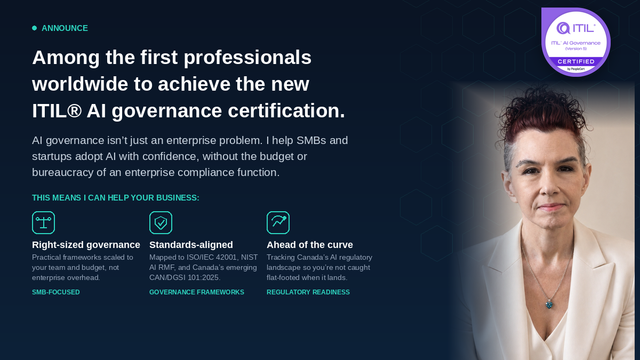
A Governance Practitioner Case Study: AI Governance for Organizations Without a Compliance Department
Most AI governance programs fail because they’re sized wrong. A framework built for an enterprise compliance department rarely survives inside a small organization.
This free case study follows the real build of an AI governance program inside a small Canadian IT firm, one that both develops AI systems for clients and uses AI tools internally, without a dedicated compliance team. It walks through the actual sequence: a full AI inventory, a regulatory lens suited to Canada’s fragmented legal landscape, an existing management system used as structural backbone, controls calibrated to risk tier, and a final validation against the NIST AI Risk Management Framework.
The organization has been anonymized. The process has not been simplified.

The Authority Gap
An Executive Governance Briefing · Strategic Edge Partners
Most Canadian organizations believe they have AI governance in place. What they have produced is documentation. The distinction carries practical weight the moment a decision produces harm.
The exposure does not live in the technology. It lives in the absence of defined authority over the decisions AI makes possible. Until that threshold is formally ratified at the right organizational level, organizations are not governing AI. They are assigning liability downward and calling it policy.
Acting early creates privacy law exposure. Acting late creates foreseeability claims. Both originate in the same structural gap. The variable is not timing. It is whether authority has been formally defined.
This briefing names the gap, maps where it lives in most Canadian organizations, and defines what closing it requires.

ADKAR IN MOTION
Why every AI adoption stall point is a people problem, not a technology one Published on LinkedIn August 3, 2026This is the sixth issue in a series building on Digital Applied’s “Change Management for AI Adoption: A 2026 Playbook,” published June 14, 2026. Their research framework is the foundation. This…

THE WIIFM PROBLEM
Published on LinkedIn July 27, 2026 Why your AI communications are answering the wrong question This is the fifth issue in a series building on Digital Applied’s “Change Management for AI Adoption: A 2026 Playbook,” published June 14, 2026. Their research framework is the foundation. This newsletter adds the practitioner…

THE TRUST GAP AND THE SHADOW AI SIGNAL
Published on LinkedIn July 20, 2026 What unsanctioned tools are actually telling you about your AI rollout This is the fourth issue in a series building on Digital Applied’s “Change Management for AI Adoption: A 2026 Playbook,” published June 14, 2026. Their research framework is the foundation. This newsletter adds…

THE REAL BLOCKER: Why AI adoption keeps stalling before it ever reaches the technology
Published on LinkedIn July 13, 2026 This is the third issue in a series building on Digital Applied’s “Change Management for AI Adoption: A 2026 Playbook,” published June 14, 2026. Their research framework is the foundation. This newsletter adds the practitioner layer: what these patterns actually look like inside organizations,…

The Rollout was never the Problem
Published on LinkedIn July 6, 2026 Why AI adoption keeps failing and what organizations keep refusing to call it 79% of organizations faced challenges adopting AI in 2026, up double-digit percentage points from 2025. That figure comes from Writer and Workplace Intelligence, who surveyed 2,400 executives and employees across industries.…

Why do organizations lose the change game before it starts?
Published on LinkedIn June 29, 2026 Only 38% of employees were willing to actively support enterprise change in 2022, down from 74% in 2016. The initiatives kept coming. The capacity to absorb them did not. Those numbers come from Gartner’s research on what they called the “transformation deficit,” reported in…
Continue Reading Why do organizations lose the change game before it starts?

The Strategy Ecosystem
Leadership work rarely fails at the level of intent. It fails at the intersection of strategy, governance, and execution, where direction exists but the operating system to carry it does not.
This work is built across three connected pillars. Strategic Edge Partners works with executives and leadership teams on strategy architecture, governance design, and operating models. Strategy Rebel focuses on leadership identity, authority, and the clarity required to lead complex organizations without sacrificing sustainable performance. The Strategic Signals newsletter goes deeper on delivery maturity, operating model debt, and the upstream leadership decisions that determine whether execution holds.
Each pillar serves a different part of the journey. Together they form a complete view of what it takes to lead organizations that actually move.

Stay grounded and informed.
You get one email every week with clear ideas that help you lead well and live well. I cover leadership, strategy, reinvention, and the habits that support sustainable performance.
- Practical leadership insights
- Midlife health and energy updates
- Reinvention tools you can use
- Real stories from the field
No noise. No spam. You can unsubscribe anytime.